

Jereh natural-gas equipment
- Group location
- Yantai, Shandong, China
- Listed group identity
- Jereh Group · Shenzhen stock code 002353
- Purchase focus
- Engineered gas compression and station systems
Specify the process before choosing the package
Jereh's natural-gas business brings together gas boosting, pressure regulation and process equipment. Its published applications include gathering and transmission, storage injection and withdrawal, fuel gas, LNG facilities and CNG stations. These are process-gas systems with a defined inlet, outlet and supply boundary.
The group's current portfolio identifies reciprocating and centrifugal compression. Select an arrangement against the actual gas and operating range; a photograph or a driver rating cannot determine the right compressor for a new site.
Group capability and the contracting company
This listing covers Jereh Group's natural-gas business. The official group site directs equipment and engineering enquiries to Jereh Oil & Gas Engineering Corporation. Agree the exact legal seller, manufacturing scope and commissioning responsibility in the quotation rather than assuming every group company supplies the same package.
Which supply boundary matches your project?
Choose between compression for a gas process and equipment for a vehicle-filling station. The two existing product entries preserve that distinction.
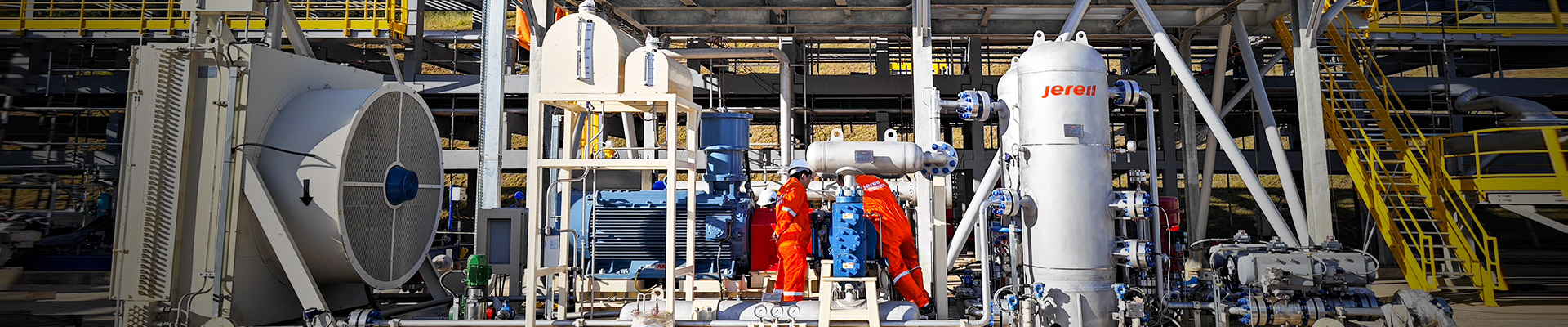
Gathering · pipeline · storage
Natural-gas boosting packages
Start here when gas needs to move from a defined suction condition to a delivery pressure for a process, pipeline or storage operation. Specify normal and limiting cases, including changing inlet pressure.
- Provide gas composition, liquid content and suction temperature.
- State throughput with its reference conditions and operating range.
- Define driver, cooling, separation and control interfaces.
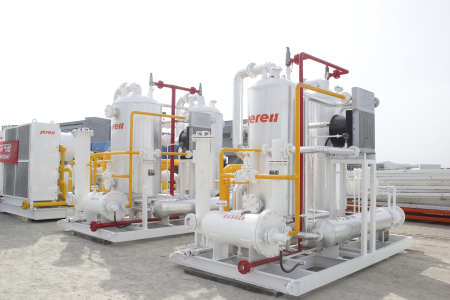
Vehicle-filling infrastructure
CNG station systems
Start with the inlet source, daily vehicle demand and filling pattern. Agree whether the request is for compression equipment or a station with gas treatment, storage, priority controls and dispensers.
- Identify the standard, mother or daughter-station concept.
- Give peak arrivals and desired filling/recovery duty.
- Separate supplied equipment from site works and local approvals.
Two published projects, interpreted correctly
Algeria · 2016
Five gas-engine-driven boosting units
Jereh reported shipping five compressor sets for the SONATRACH-FCP Block 405B project, each described with a 1,253 kW gas-engine drive. This is evidence of a specific engineered supply, not a standard power rating for all Jereh gas packages.
The gas product photograph shows a portfolio installation; it does not identify these five Algeria units.
Uzbekistan · April 2016
Two standard CNG stations
The company reported designing and manufacturing two stations with regulator, metering, dehydration, compressor and fueling modules tailored to the customer. The station photograph belongs to that historical shipment.
The report supplies no exact model, pressure/flow selection or driver rating for those pictured units. Request the current configuration for your duty.
Build a duty sheet the engineering team can use
For these engineered systems, matched conditions are more useful than an unqualified maximum pressure or power range.
| Selection input | What to specify | What it resolves |
|---|---|---|
| Gas and inlet | Composition, contaminants, liquids; suction pressure and temperature at minimum, normal and maximum conditions. | Gas handling, materials, separation and the compression arrangement. |
| Delivery and flow | Required discharge pressure and throughput at stated standard/normal reference temperature and pressure. | A selection with a clear volume basis and defined design cases. |
| Driver and utilities | Electric supply or available fuel; cooling utilities, ambient, altitude and operating hours. | Driver choice, utility demand and site integration. |
| Station duty | Inlet supply, daily volume, peak vehicle arrivals, storage and dispenser scope. | CNG compression/recovery requirements and station boundaries. |
Comparing two proposals?
Use the same gas composition, inlet/outlet cases, reference-volume basis and supply boundary. Ask each seller to identify driver output separately from package utility consumption. Include auxiliaries, controls and cooling before comparing totals.
Turn packaging capability into order documents
Jereh's published project reports describe compressor packaging, design and manufacture; the Uzbekistan example also shows integration of gas-treatment and fueling modules. Define how that integration will be documented for your order.
Approve the selection
Request the named compressor, stage arrangement, duty calculation or curve, driver selection and gas-condition limits. Agree the required turndown and abnormal operating cases.
Approve the interfaces
Request a package P&ID, arrangement drawing, connection schedule, electrical/control interfaces and utility list. Allocate gas treatment, storage, dispensers, civil works and installation explicitly.
Agree acceptance and support
Set the inspection and test plan, applicable destination requirements and release documents. Agree commissioning, training, manuals, consumables and spare-parts responsibilities before shipment.
These are documents and responsibilities for the buyer to agree with the seller; they are not a promise of a particular test, certificate or service included in every package.
Prepare a Jereh enquiry in three parts
1. Process brief
Describe the gas source and intended service. Attach composition and inlet/outlet design cases, flow basis and operating schedule. For a CNG station, include the inlet arrangement and vehicle-filling pattern.
2. Site and interfaces
State location, ambient/altitude, available fuel or power, cooling, footprint and hazardous-area requirements. Mark interfaces to existing process, storage or dispensing equipment.
3. Scope and approval
Identify compressor-only or integrated supply, required engineering documents, acceptance tests, destination requirements and delivery responsibilities. Ask for the named seller and model-specific proposal.
Questions about these gas systems
Can I use the Algeria project's 1,253 kW for a CNG station?
No. It is the reported driver rating for a particular 2016 boosting project. A CNG selection needs its own inlet, throughput, filling pattern, discharge requirement and driver calculation.
Does the CNG photograph specify a current model?
It shows units from a historical station shipment. Use it to discuss supply scope, then request a current model and paired pressure/flow data for the proposed station.
Is a compressor package the same as an EPC contract?
No. The group describes both equipment and engineering businesses, but a particular quotation must allocate design, equipment, construction, installation and commissioning. Confirm the contracting entity and exclusions.
Can these products replace a workshop air compressor?
These entries concern natural-gas process and CNG systems. A workshop air duty requires a different selection; gas-service package references do not establish an air-compressor rating.