

Bingshan in Dalian
- Listed company
- Bingshan Refrigeration & Heat Transfer Technologies Co., Ltd. (冰山冷热科技股份有限公司)
- History
- 1930 · Shenzhen listing in 1993
- Stock codes
- 000530 / 200530
- Industrial parks
- Dalian and Wuhan
A refrigeration business with an engineering supply chain
The listed company, formerly Dalian Refrigeration Co., Ltd., is part of Dalian Bingshan Group. Its portfolio covers refrigeration compressors and units, pressure vessels, cold storage and freezing equipment, absorption equipment and heat pumps.
The 2025 annual report describes design, manufacture, installation and maintenance capabilities. For an equipment enquiry, identify the actual manufacturer and engineering contractor, together with the parts of the refrigeration plant included in their offer.
Start with the load
Define a refrigeration duty before comparing kW
Refrigeration capacity depends on refrigerant and thermal conditions. Keep the conditions alongside each number in a selection or quotation.
| Duty | Information the supplier needs |
|---|---|
| Steady production | Required thermal load, refrigerant, evaporating/condensing conditions and operating hours |
| Pull-down / freezing | Product or room starting condition, target temperature, load and permitted time |
| Part-load / seasonal | Minimum demand, heat-rejection conditions, control requirements and permitted operating cases |
Refrigerant displacement is not compressed-air free-air delivery. A thermal kW rating should not be treated as motor kW.
Compressor arrangement
Two stages can mean different equipment
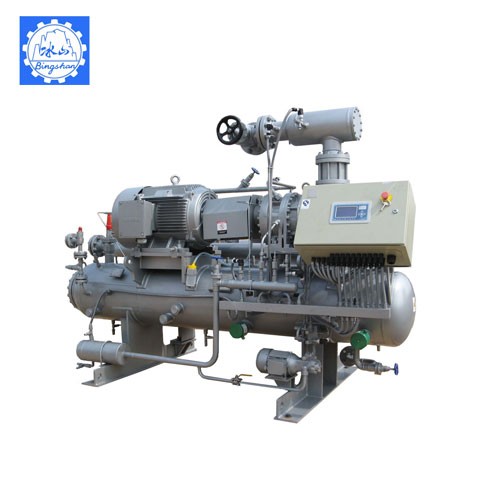
JZSLG two-stage screw family
The engineering/export catalogue identifies R717 configurations including JZSLG16/12.5CS and JZSLG20/16SS. The full model and current selection sheet define the arrangement and refrigerant duty.
- Single two-stage unit
- Identify the integrated low- and high-stage arrangement, drive, oil cooling and controls for the offered model.
- Dual-compressor rack
- A separate catalogue route describes independently driven low- and high-stage compressors on a rack. Request both machines' selected duties and the interstage/system arrangement.
Ask for capacity and input at your operating cases, the permitted envelope and part-load behaviour. A family name alone does not define the two stage capacities or system balance.
Review compressor enquiry information →Reciprocating compression
Piston refrigeration units: confirm the current model first
Bingshan's 2025 annual report lists piston-type refrigeration machines and units among the company's main products, alongside screw, scroll and lithium-bromide absorption equipment. The engineering and export catalogue of Dalian Bingshan Engineering & Trading groups a separate Piston Compressor Unit Series: marine/land single-stage and dual-stage piston compressor units, a semi-hermetic piston central unit and a semi-hermetic piston compressor unit. The same catalogue includes piston units in its cold-storage scope, which it describes from −65 °C to +10 °C, and records piston-compressor exports in the company history.
The current Bingshan website does not publish a piston model page or rating table, and the catalogue is a historical engineering document. Treat it as a description of the range, not a current model list. For a reciprocating enquiry, ask for:
- the current model designation, number of cylinders and stages, and the refrigerant, for example R717 or a halocarbon;
- capacity and shaft input at your evaporating and condensing temperatures, not a nominal size;
- marine or land execution, and the classification-society or pressure-equipment documents your project needs;
- the unit scope: driver, oil separator and cooler, controls, and which heat exchangers are included.
Compare a piston offer with a screw offer at the same operating cases. The choice depends on load range, part-load operation and service arrangements, not on the compressor type alone.
Indirect cooling
Specify the glycol circuit as well as the compressor
LSVLGF open-type screw chiller
This named catalogue route uses an adjustable internal volume ratio and capacity regulation, with chilled-water and ice thermal storage operating arrangements. Listed applications include process cooling and food/beverage plants.
These modes have different thermal conditions. Require a current model selection for the actual secondary fluid and temperatures; a mode's capacity range does not define the other mode or your system.
Review refrigeration package information →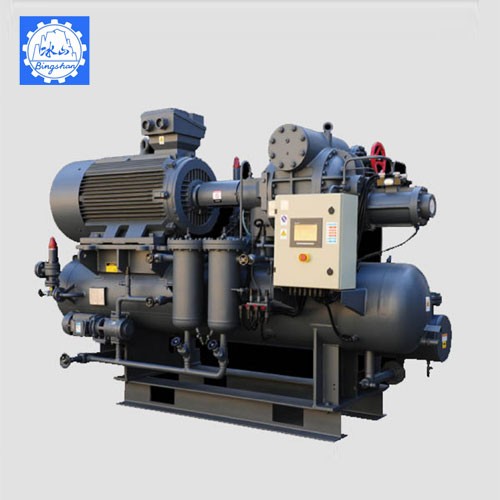
- Fluid
- Type, glycol concentration and required freeze protection
- Temperatures
- Entering and leaving fluid temperatures for each required mode
- Hydraulics
- Flow, permitted pressure drop, pump boundary and fouling allowance
- Heat rejection
- Available cooling medium, site conditions and condenser boundary
The catalogue identifies low-flow, low leaving-water temperature and refrigerant-pressure protection functions. Agree their implementation, setpoints and interfaces on the offered system.
Draw the line between the unit and the refrigeration plant
Bingshan's engineering range serves cold storage, food freezing and process cooling. Define direct refrigerant cooling or an indirect secondary-fluid circuit, then identify who supplies each part.
Equipment
- Compressor unit, driver and oil system
- Condensers, evaporators and pressure vessels
- Pumps, valves and refrigeration accessories
- Power and control equipment
Site & operation
- Piping and utility interfaces
- Foundations, lifting and service access
- Installation, commissioning and training
- Service response and spare-parts supply
| Document | What to resolve |
|---|---|
| System diagram / equipment list | Included equipment, refrigerant/secondary-fluid circuits and site interfaces |
| Performance and electrical schedule | Cooling and input at agreed conditions; motor, auxiliary and system boundaries |
| Inspection / pressure-equipment records | Applicable destination requirements, equipment scope and acceptance checks |
| Handover and maintenance | Control/interlock schedule, operating limits, commissioning roles and spares |
Make the refrigeration enquiry ready for selection
Load and temperature
Thermal duty, refrigerant or secondary fluid, operating cases, product throughput and pull-down/production schedule.
Arrangement and interfaces
Compressor architecture, circuit boundary, utilities, heat rejection, control integration and equipment to be supplied.
Acceptance and service
Required selection/performance records, destination documents, inspection scope, access drawings, commissioning and spares.
Resolve these points before comparing offers
Is cooling capacity the same as motor power?
No. Cooling kW is thermal output at specified conditions. Shaft power and electrical input are different quantities. Request all three with their operating cases and equipment boundaries.
Does “two-stage” identify one compressor or a rack?
The catalogue includes a two-stage unit family and a separate dual-compressor rack route. Ask for the complete model and arrangement drawing, including drivers and interstage connections.
What is missing from a glycol-chiller enquiry?
Often the fluid concentration, entering/leaving temperatures, flow, pressure-drop allowance and heat-rejection conditions. These are needed alongside the required thermal load.
Does a compressor offer include the cold-store system?
Only the agreed equipment and scope list can establish this. Identify heat exchangers, vessels, pumps, piping, controls, site work and commissioning responsibilities individually.